It Started With One Weird Thing: How Americans Are Accidentally Discovering Who They Are Through What They Can't Throw Away
Marcy didn't set out to collect vintage salt and pepper shakers. She was cleaning out her grandmother's kitchen in rural Ohio, and there they were — a pair of ceramic roosters, chipped at the beak, painted in colors that had no business being that cheerful. She almost put them in the donation box. Almost.
Four years later, her kitchen shelves hold 200 pairs. There are poodles. There are lighthouses. There are tiny astronauts that she found at a flea market in Tucson and still isn't sure are real or a fever dream. And when people ask her about herself at parties, she doesn't say she's an accountant anymore. She says she collects salt and pepper shakers.
"It told me something about who I am that I didn't know before," she says. "I'm someone who finds joy in the overlooked."
This is happening all over America, and it's one of the most quietly wonderful things going on right now.
The Museum You Didn't Mean to Build
Psychologists have a term for the relationship we develop with meaningful objects: extended self theory. The idea, first proposed by consumer behavior researcher Russell Belk, is that our possessions become genuine extensions of our identity — not just things we own, but pieces of who we actually are.
But what's fascinating about the accidental collector is that the process works in reverse. Most people think you find yourself first and then build a life that reflects it. Accidental collectors find their stuff first, and the self-discovery follows.
A kept object is a vote. Every time you decide something is too meaningful to release, you're casting a ballot for a version of yourself. And after enough votes, a picture emerges.
That picture can be startling in the best possible way.
'I Didn't Know I Loved This Until I Loved It'
Derek, a high school history teacher in Portland, Oregon, started buying vintage travel pennants because he found one at a yard sale for fifty cents and thought it looked cool in his classroom. That was seven years ago. He now has pennants from 47 states, dozens of national parks, and a handful of international destinations that made their way into American collections decades ago.
"My students ask about them constantly," he says. "It opens up conversations about American geography, about tourism history, about what we've valued as a culture at different times. It accidentally became part of how I teach."
For Derek, the collection didn't just reveal a passion — it deepened his professional purpose.
This is a pattern that shows up again and again in the stories of accidental collectors. The thing you keep doesn't just tell you what you like. It tells you what you need.
Sometimes it's beauty. Sometimes it's history. Sometimes it's humor — Renata in Chicago has an entire cabinet of novelty spoons from roadside attractions and says the collection is basically a love letter to American kitsch. "I collect absurdity," she explains, laughing. "That probably says everything about how I survive the news cycle."
The Flea Market, the Thrift Store, and the Algorithm
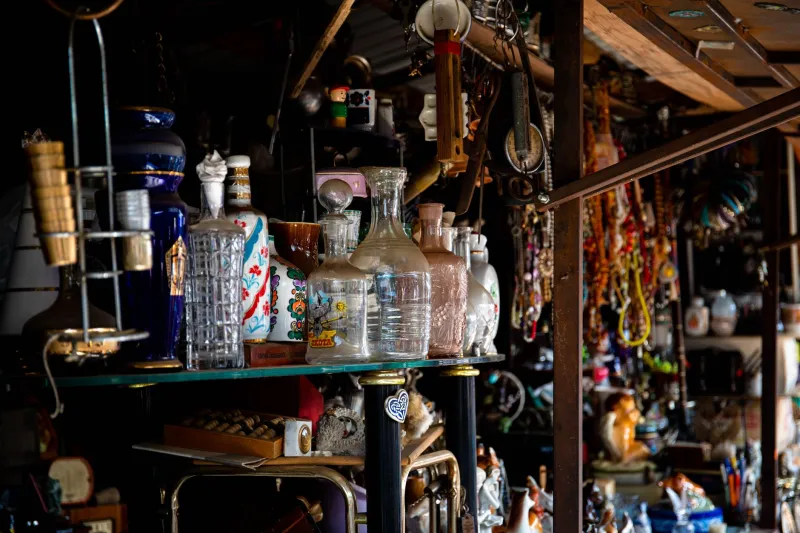
The places Americans stumble into accidental collections have shifted. Yes, flea markets and estate sales still work their particular magic — there's something about the sensory chaos of a good swap meet that makes the brain loosen up and say yes to things it might otherwise overthink. But increasingly, the accidental find is happening online.
Etsy rabbit holes. Facebook Marketplace scrolls at midnight. The Instagram account you followed for one post and then suddenly realized had rewired your entire aesthetic. The algorithm, for all its complicated reputation, has become an unlikely curator of personal identity.
Jameel, a software developer in Austin, found his collection — hand-painted wooden signs from small American towns — through a single image that appeared in his Instagram feed. "I didn't even know these existed as a category of thing," he says. "But I saw one and something in my brain went, yes, that. Now I have 30 of them and I'm planning road trips specifically to find more."
The collection has become his travel itinerary. His travel itinerary has become his social life. His social life has become his happiest self.
What You Keep Is What You Are
There's a reason the Marie Kondo method resonated so deeply with Americans — and also a reason so many people quietly abandoned it after a few months. The question "does this spark joy?" is genuinely useful. But it assumes you already know what joy looks like for you.
Accidental collectors suggest another approach: keep the thing, and let it tell you.
The objects that we can't release, even when we can't explain why, are often carrying information about us that our conscious minds haven't caught up to yet. The snow globe that reminds you of a feeling you can't name. The concert ticket stub you moved through three apartments. The ugly little figurine a stranger pressed into your hand at a craft fair because, they said, "this one's yours."
These things are breadcrumbs. Follow enough of them and you find yourself somewhere surprising.
The Joy of the Unintentional Museum
What makes the accidental collection so different from the deliberate one is the absence of ego in its formation. A planned collection can become a performance — a statement about taste and knowledge and cultural capital. An accidental collection is just honest.
It's also, often, more fun to live with. Marcy's salt and pepper shakers don't match. Derek's pennants are pinned at slightly different angles. Renata's novelty spoons are crammed into a cabinet that technically isn't big enough. None of it is curated in any traditional sense.
But every single piece is wanted. Every single piece was chosen — even if the choosing happened in a split second at a dusty folding table with three dollars in your pocket.
There is something genuinely magical about a home full of things that found you as much as you found them. It's a personal museum built not from expertise or intention, but from instinct and openness and the small, brave act of saying maybe I'll keep it.
That maybe, repeated enough times, becomes a whole beautiful life.
Start Your Accidental Collection Today
You probably already have one. Look around. What's the thing you've moved four times and still haven't gotten rid of? What's the category of objects you seem to own more of than you realized? What do people notice when they walk into your space and ask, "wait, do you collect these?"
That's the beginning. That's you, curating yourself without even trying.
Let it keep going. Say maybe I'll keep it to one more thing this weekend. See what it tells you.
You might be surprised by who you're becoming.