When You Share What You Love, Something Magical Happens to Both of You
There's a moment — you probably know the one — where someone you care about tries something you've loved for years, and their face just opens up. Their eyes get a little wider. Maybe they laugh. Maybe they go quiet in that particular way that means they're completely hooked. And somewhere in your chest, something warm and almost indescribable happens.
That feeling? It has a name, a backstory, and a whole lot of science behind it. And it turns out, it might be one of the most underrated sources of joy available to any of us, completely free and hiding in plain sight.
The Moment It Clicks for Them — and for You
Ask anyone who has ever taught someone else something they genuinely love, and they'll tell you the same thing: the moment the student gets it feels almost better than when you discovered it yourself.
Marcus, a 38-year-old high school history teacher from Columbus, Ohio, picked up woodworking during the pandemic. He spent months fumbling alone in his garage, watching YouTube tutorials at midnight, slowly building something resembling a bookshelf. Two years later, he invited his teenage nephew to come work on a project with him one weekend.
"I didn't expect much," Marcus admits. "I figured he'd be bored in twenty minutes. But he got obsessed with the joinery — how pieces fit together without nails — and he just lit up. Watching him figure that out, I felt proud in a way I never felt about my own work. It was like experiencing it fresh all over again."
This is what psychologists sometimes call the "protégé effect" — the well-documented phenomenon where teaching something to someone else deepens your own understanding and reignites your own enthusiasm. But beyond the cognitive benefits, there's something profoundly emotional happening too. Sharing what you love is an act of vulnerability. You're essentially saying: this matters to me, and I think it might matter to you too. When that bet pays off, the connection that forms is unlike almost anything else.
Why Generosity Multiplies Joy Instead of Dividing It
There's a common misconception that sharing something precious somehow dilutes it — that if you give away your favorite recipe, your secret hiking trail, your most treasured playlist, it becomes less yours. But most people who've actually done it report the opposite.
Joy, it turns out, is not a finite resource.
Research from the University of British Columbia found that spending time or energy on others — even in small ways — consistently boosted the happiness of the giver more than spending the same resources on themselves. And when that generosity is wrapped around something personally meaningful, the effect is amplified.
Lena, a 52-year-old librarian in Portland, Oregon, has spent the last decade doing what she calls "precision gifting" with books. Not just recommending titles, but carefully matching the right book to the right person at exactly the right moment in their life.
"I gave my neighbor's daughter A Wrinkle in Time when she was going through a rough patch in middle school," Lena says. "A few months later, the girl came back and told me it was the first book she'd ever finished in one sitting. I cried in the parking lot afterward. Genuinely cried. Over a book I've read probably six times."
The joy didn't diminish because she shared it. It doubled.
The Ripple You Don't Always Get to See
One of the most quietly beautiful things about teaching someone else a skill or sharing a passion is that you often don't get to witness the full ripple effect. You plant a seed, and then life carries that person somewhere you can't follow.
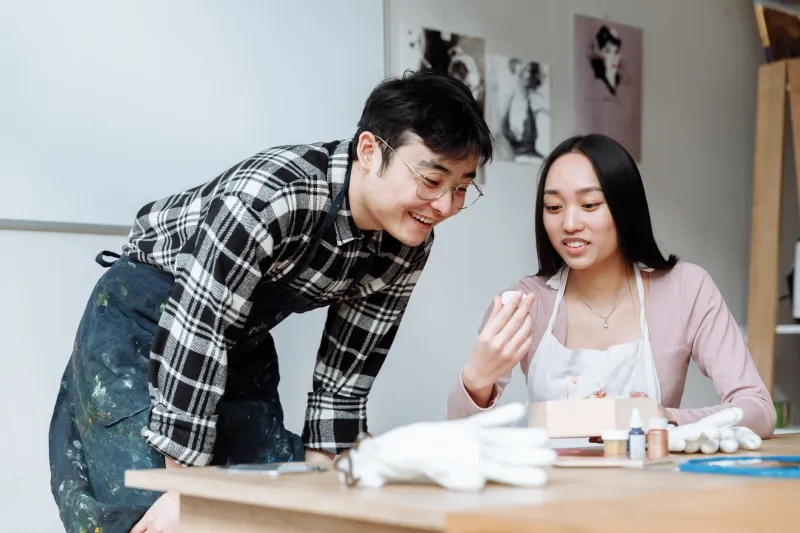
Diana, a 44-year-old ceramics teacher in Austin, Texas, remembers a student who seemed completely disengaged during her beginner workshop — fidgety, distracted, clearly dragged there by a well-meaning partner. Three months later, she got an email from him. He'd set up a small pottery wheel in his apartment. He'd taught his eight-year-old daughter how to make pinch pots. His daughter had brought one to school for show and tell and told her class she wanted to be an artist.
"I taught one skeptical guy how to center clay on a wheel," Diana says, still a little stunned by the memory. "And somewhere down the line, a little girl decided she was an artist. That's the part you don't plan for."
This is the ripple effect in its purest form — the way a single act of generous sharing can travel through people and time in ways the original teacher will never fully know.
You Don't Have to Be an Expert to Be a Guide
Here's the part that trips a lot of people up: the belief that you have to be exceptionally skilled at something before you're "allowed" to share it. That you need credentials, mastery, or years of experience before your passion is worth passing on.
You don't.
Enthusiasm is contagious in a way that expertise rarely is. A person who is deeply, genuinely excited about sourdough bread — even if their loaves are lopsided — will teach more effectively than a technically perfect baker who can't remember what it felt like to be a beginner.
Being a guide doesn't require a certificate. It requires showing up with honesty, patience, and a willingness to say "I don't know everything, but I know this is worth your time."
That's enough. In most cases, that's everything.
How to Start Sharing What You Love
If this is sparking something in you — a quiet nudge toward a person in your life who might love what you love — here are a few low-pressure ways to begin:
- Start with an invitation, not a lesson. Instead of saying "I'll teach you," try "Want to come do this with me sometime?" Lower stakes, same magic.
- Pick one person. Not a class, not a group text. One specific person who you think might genuinely connect with this thing you love.
- Give them permission to not love it. The pressure to perform enthusiasm can kill the experience. Let them try it honestly.
- Share the story behind your passion. How did you find it? What did it feel like the first time? That context is often what hooks someone more than the activity itself.
- Be patient with the messy beginning. Everyone starts awkward. The mess is part of the magic.
The Gift That Comes Back to You
There's a reason that some of the most joyful people you'll ever meet are teachers, mentors, coaches, and guides — not just professional ones, but everyday ones. The neighbor who taught you to change your own oil. The coworker who walked you through your first sourdough starter. The aunt who sat with you at the piano until your fingers found the right keys.
They gave something away and somehow ended up with more than they started with.
That's not a paradox. That's just how joy works when you stop hoarding it.
So — what do you love? And who in your life is waiting, without even knowing it, for you to share it with them?